HackHub Ultimate Hacker Simulator HackTheCube Challenge Levels
Puzzle stages, password hunts, and the recon-to-crack loop outside the main campaign.
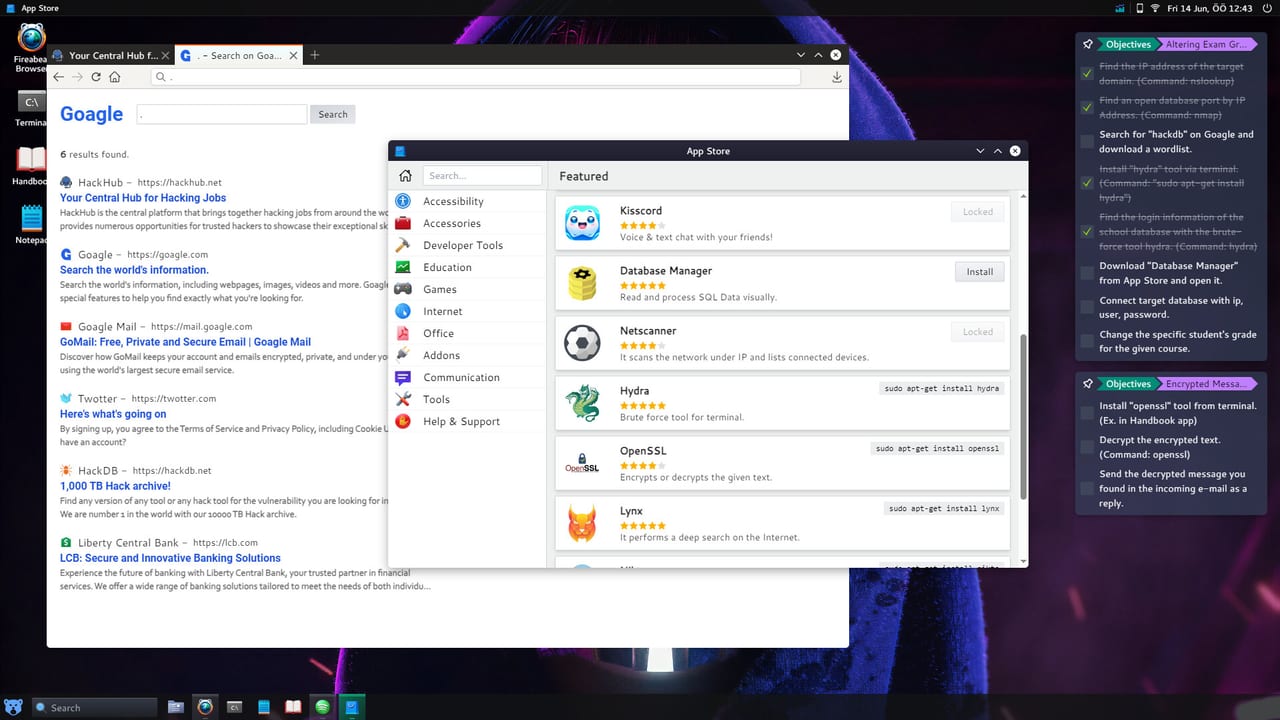
HackTheCube is HackHub Ultimate Hacker Simulator’s structured challenge mode — a ladder of self-contained puzzle levels that stress-test the same terminal skills you use in contracts and The Journalist’s Sister, but without narrative mail or evidence chains. HotBunny ships these stages inside the full Steam release (app 2980270) and iterates them through patches after the August 1, 2026 version 1.0 launch. Every level randomizes hosts, credentials, and file paths per attempt, so this guide teaches process — not passwords copied from a screenshot.
If HackTheCube is your first exposure to the desktop, read Getting Started for terminal basics before attempting mid-tier floors. Players who already finished story chapters should treat HackTheCube as a speedrun gym: fewer hand-holding prompts, tighter objective text, and no contract payouts funding your shop.
How HackTheCube differs from story missions
Story missions like Journalist’s Sister weave objectives through mail threads, NPC online gates, and router forwarding fiction. HackTheCube strips that layer away:
| Aspect | Story missions | HackTheCube levels |
|---|---|---|
| Objective delivery | Mail, phone, journal apps | In-level briefing panel only |
| Economy | Contract payouts fund tools | Loadout usually pre-granted |
| Failure recovery | Manual saves + evidence rollback | Restart level or checkpoint |
| Social engineering | Phishing, Twotter, waiting for NPCs | Rare — pure network puzzles |
| Randomization | Per save seed | Per level attempt |
You will still run whois, nmap -sV, Metasploit, and crackers — the toolchain matches the Tools hub — but you cannot brute-force progress by rereading old mail. When a level says “find the password,” it means derive it from logs, configs, or crackable hashes on your instance.
Level structure and progression
HackTheCube organizes floors by skill theme rather than plot chapter. Early floors teach host discovery and single-service exploitation. Mid floors combine database access, web enumeration, and file hunts across two subnets. Late floors expect you to chain recon → exploit → credential recovery → proof upload without the journal hinting which app to open.
Progression is linear within a cube run: completing floor N unlocks N+1. Some builds gate advanced floors behind story milestones or 1.0 multiplayer rank — check your client version against Full Release 1.0 notes if a floor stays locked despite prior clears.
The recon-to-crack loop
Most HackTheCube stages reduce to a repeatable loop. Adapt the placeholders every attempt:
- Read the briefing — note domain, service hint, or file name pattern.
- Resolve the target —
whois <briefing-domain>or parse the level’s localhostsfile if provided. - Enumerate —
nmap <discovered-ip> -sVand log every open port with version strings. - Initial access — Metasploit module matched to your banner, or default creds from looted config files.
- Credential recovery —
john,hashcat, orhydraagainst hashes or login services you confirmed in step 3. - Proof — place the flag file, edit the database row, or submit the recovered password in the level UI.
If step 3 shows closed ports, you missed a prerequisite inside the level — hidden VM, second interface, or a zip archive on the desktop. Rescan after exploring the in-game filesystem; do not assume the briefing IP is the final host.
Password find mechanics
“Password find” floors reward careful reading over guessing. Common patterns in randomized layouts:
- Config fragments —
grep -i passacross/etc, application folders, or downloaded.envfiles. - Log redaction — partial passwords in
auth.logorsys.logwhere you combine two lines. - Hash files —
hashes.txtor shadow exports meant for Password Cracking with the level-supplied wordlist path. - Database rows — after sqlmap or manual SQL login, a
userstable column holds the next-stage secret.
Never type dictionary guesses at the level login prompt unless the briefing mentions brute force. HackTheCube expects you to earn the string through tooling.
Code++ and automation on cube floors
Several floors optionally accept Code++ submissions — automate a scan sweep or parse a log file under a timer. These are puzzles about the in-game language API, not external cheats. Parameterize every host and path:
string target = Mission.getObjectiveNetwork();
Terminal.run("nmap -sV " + target);
Hardcoding 192.168.1.10 fails on the next attempt when HotBunny rerolls the subnet. The embedded video on this page demonstrates pacing for visual learners; written steps remain complete without it.
Metasploit and sqlmap on cube targets
When nmap -sV reports a vulnerable web stack or database port, follow the same discipline as story content:
msfconsole
search <service-from-scan>
use <module>
show options
set RHOST <your-target-ip>
set RPORT <open-port-from-scan>
exploit
For injectable HTTP forms discovered after browsing the level’s internal site, see sqlmap for --dbs and table enumeration — dump only the tables the objective names to avoid unnecessary noise on timed floors.
Common failure modes
- Wrong host — scanning the gateway instead of the app server labeled in the topology sketch.
- Stale scan — exploiting a service that closed after you triggered a level event; rerun
nmap -sV. - Skipped crack step — attempting the final login with a hash instead of the cracked plaintext.
- Notepad overwrite — editing hints in the desktop Notepad without saving before a level restart clears unsaved buffers (see Troubleshooting).
Relation to achievements and multiplayer
Some Steam achievements track HackTheCube clears or no-restart floor completions. Multiplayer does not co-op standard cube ladders — treat floors as solo practice before jumping into Multiplayer procedural company worlds where the same recon habits matter under PvP pressure.
Recommended practice order
- Clear Getting Started tutorial objectives.
- Finish at least one story chapter for Metasploit muscle memory.
- Attempt HackTheCube floor 1 with a scratch notes file open.
- On failure, read Troubleshooting before blaming RNG.
- Return to cube floors after learning sqlmap for database-heavy stages.
Patch awareness
HotBunny adjusts cube difficulty and fix softlocks through G-DEVS.com / Games Operators patches. Compare your Steam build date with the Updates hub if a floor objective shows ? — that UI state usually means a trigger was missed, not a removed level. Post-1.0 builds align cube tooling with the same command set documented on Commands Reference.
HackTheCube exists to prove you understand why each command runs, not to memorize one creator’s lucky roll. Beat a floor using only IPs and passwords you discovered in that attempt — that is the skill the mode is designed to reward.
Frequently Asked Questions
Quick answers to common HackHub questions.
Does HackTheCube use the same randomized networks as story mode?
Yes. Each cube attempt rolls its own hosts and credentials. Follow recon and crack steps on your current run instead of copying old answers.
Do I need to finish the Journalist story before HackTheCube?
Early floors are standalone. Some later floors may expect tools you unlock mid-campaign, but the mode is designed as parallel practice.
Can Code++ scripts solve HackTheCube levels?
Some levels allow or require Code++ submissions. Parameterize targets from mission APIs — hardcoded IPs break on the next attempt.
Where does the HackTheCube video belong versus Code++?
The HackTheCube walkthrough video is on this page. The Code++ language guide focuses on syntax and APIs without a duplicate embed.
What if a cube level shows no open ports?
Reread the briefing, check for local files or second interfaces, and rescan after any in-level event. See the Troubleshooting guide for softlock patterns.